
Superior Protection Beyond Flu of High-Dose Flu Vaccine vs Standard-Dose Flu Vaccine*`, author: ``, tags: `Vacciner | Influenza`, publication_date: ``, interaction_type: "content" }
FLUNITY-HD Study Demonstrated the
Superior Protection Beyond Flu of High-Dose Flu Vaccine vs Standard-Dose Flu Vaccine*
FLUNITY-HD is the largest individually randomised influenza vaccine effectiveness study, with nearly half a million older adults across multiple seasons.1
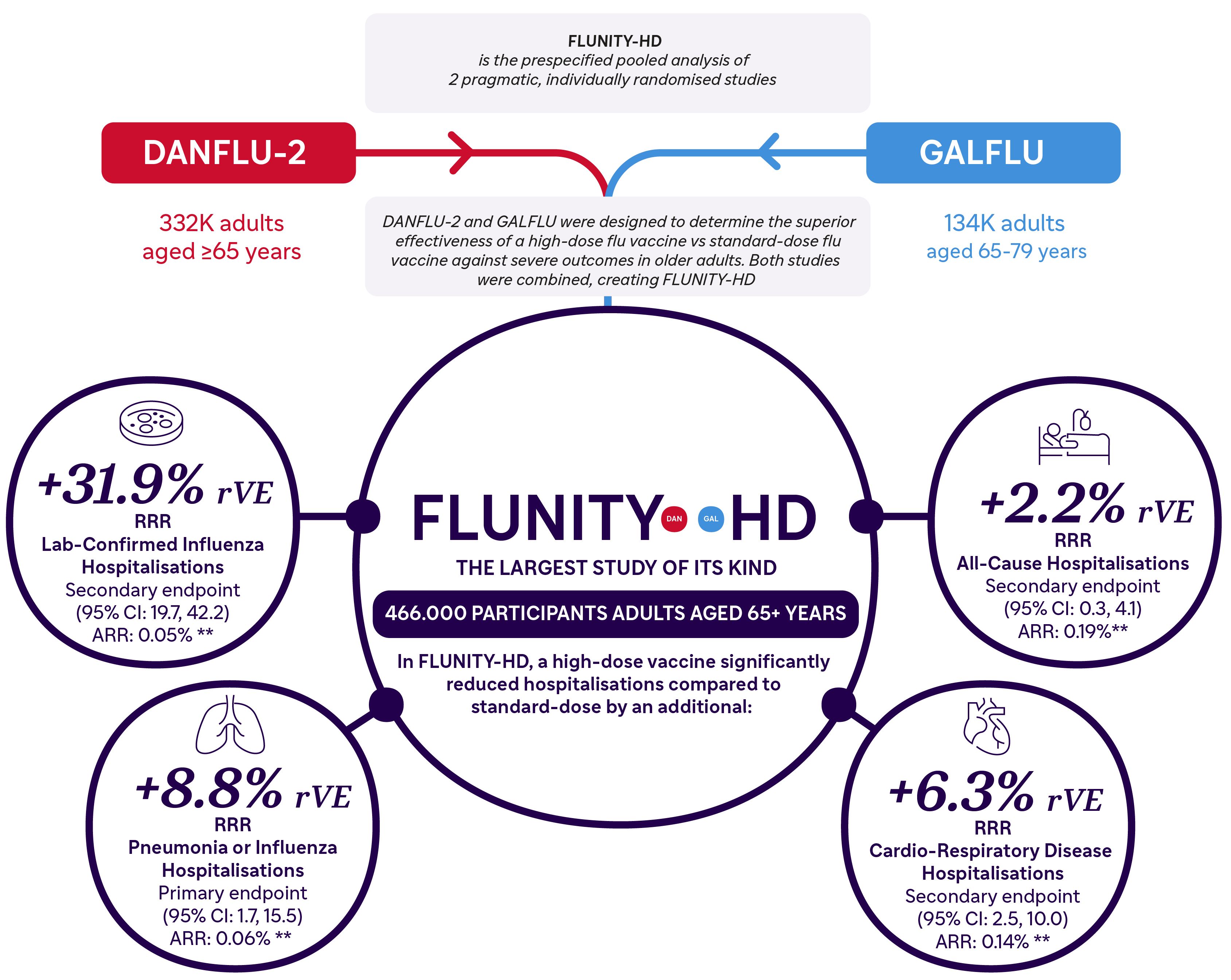
FLUNITY-HD joins a growing body of data demonstrating the superiority of high dose vaccine against standard-dose*. |
All-cause mortality was also assessed as a secondary endpoint endpoints as part of the hierarchical testing sequence.
CI=confidence interval; rVE=relative vaccine efficacy; RRR: Relative Risk Reduction; ARR: Absolute Risk Reduction.
Before administration, please see the full SmPC.
*The standard-dose influenza vaccines used in the study were VaxigripTetra (Sanofi) and InfluvacTetra (Viatris). Standard-dose vaccines often serve as the primary influenza prevention option for the general population.
** The absolute risk reduction was calculated from the original event rates reported in the HD-IIV group (n=233,311) and SD-IIV group (n=233,009), Table 2 in original publication.
FLUNITY-HD: Expanding Protection Beyond Flu
FLUNITY-HD is the largest flu vaccine study of its kind |

This STUDY adds to the vast body of evidence showing the superior protection beyond flu of high-dose flu vaccine vs standard-dose*

The FIRST** high-dose flu vaccine to demonstrate superior protection against both flu infection and its complications in robust, individually randomised studies1,2

Over 15 years of clinical evidence spanning over 45 million older adults.3

A well-established safety profile3
FLUNITY-HD has demonstrated superior protection against flu-related hospitalizations***, providing public health decision makers and health care professionals the clinical evidence they need to make their influenza vaccine choice for older adults. |
*The standard-dose influenza vaccines used in the study were VaxigripTetra (Sanofi) and InfluvacTetra (Viatris). Standard-dose vaccines often serve as the primary influenza prevention option for the general population.
**Without prejudice to existing other types of real-world studies.
***DANFLU-2 covered the 2022-2023, 2023-2024, and 2024-2025 seasons, and GALFLU covered the 2023-2024 and 2024-2025 seasons.
Make high-dose flu vaccine your choice for protection beyond flu. |
Pivotal Trial
High-dose flu vaccine demonstrated superior protection vs standard dose* in a randomised controlled trial of over 31,000 patients.2
24.2% SUPERIOR PROTECTION AGAINST FLU INFECTION VS STANDARD DOSE* (95% CI: 9.7, 36.5)
Primary endpoint: Relative vaccine efficacy against flu due to any lab-confirmed circulating strains.
CI=confidential interval
The pivotal trial was a multicentre, double-blind efficacy trial over 2 seasons assessing the occurrence of laboratory-confirmed influenza in association with influenza-like illness (ILI) with high-dose vaccine (n=15,892) vs standard-dose* vaccine (n=15,911) as the primary endpoint, starting 2 weeks post-vaccination and lasting for approximately 7 months.2
*The standard-dose influenza vaccines used in the study were VaxigripTetra (Sanofi). Standard-dose vaccines often serve as the primary influenza prevention option for the general population.
High-Dose Flu Vaccine Safety3
The safety of high-dose flu vaccine was assessed in a pooled analysis of 2 clinical trials (QHD00013 and QHD00011) in which 2549 adults 60 years of age and older (378 adults from 60 to 64 years of age and 2171 adults 65 years of age and older) received high-dose vaccine.
The most frequently reported adverse reaction after vaccination was injection-site pain, reported by 42.6% of study participants, followed by myalgia (23.8%), headache (17.3%), and malaise (15.6%). Most of these reactions occurred and resolved within 3 days of vaccination. The intensity of most of these reactions was mild to moderate.
Overall, adverse reactions were generally less frequent in participants aged ≥65 years than in participants aged 60 to 64 years.
The reactogenicity of the high-dose vaccine was slightly increased compared to the standard-dose vaccine, but no major difference in intensity was observed.
Before administration, please see the full SmPC.
Efluelda®, (Trivalent influenza vaccine (split virion, inactivated)), suspension for injection in pre-filled syringe, 60 micrograms HA/strain
A/Victoria/4897/2022 (H1N1) pdm09-like strain, A/Croatia/10136RV/2023 (H3N2)-like strain, B/Austria/1359417/2021 -like strain
- Compulsory Information
Presentation: Efluelda contains 60 micrograms of antigen (per 0.5 mL) from each of the three virus strains recommended by the World Health Organization for the present influenza season. It is supplied as a single dose pre-filled syringe containing 0.5 mL of suspension for injection. The vaccine may contain traces of eggs, such as ovalbumin, formaldehyde which are used during the manufacturing process. Indication: Efluelda is indicated for active immunisation in adults 60 years of age and older for the prevention of influenza disease. Efluelda should be used in accordance with official recommendations on vaccination against influenza. Dosage and administration: In adults 60 years of age and older: one dose of 0.5 ml. The preferred route of administration is intramuscular although it may also be given subcutaneously. The recommended site for intramuscular injection is the deltoid region. It should not be injected into the gluteal region, or into areas where there may be a major nerve trunk. The safety and effectiveness of Efluelda in children less than 18 years of age have not been established. Contraindications: Hypersensitivity to the active substances or to any of the excipients or to any component that may be present as traces such as eggs (ovalbumin, chicken proteins) and formaldehyde. Warnings and precautions: In order to improve the traceability of biological medicinal products, the name and the batch number of the administered product should be clearly recorded. Appropriate medical treatment and supervision should always be readily available in case of an anaphylactic reaction following the administration of the vaccine. Do not administer intravascularly. Vaccination should be postponed in patients with acute febrile illness until the fever is resolved. If Guillain-Barré syndrome (GBS) has occurred within 6 weeks of any previous influenza vaccination, the decision to give Efluelda should be based on careful consideration of the potential benefits and risks. The vaccine should be administered with caution to subjects with thrombocytopaenia or a bleeding disorder since bleeding may occur following an intramuscular administration to these subjects. Syncope (fainting) can occur following, or even before, any vaccination as a psychogenic response to the needle injection. Procedures should be in place to prevent injury from fainting and manage syncopal reactions. Antibody response in patients with endogenous or iatrogenic immunosuppression may be insufficient. As with any vaccine, a protective response may not be elicited in all vaccine recipients. Efluelda contains less than 1 mmol sodium (23 mg) per dose, i.e. essentially “sodium free”. Interactions: Co-administration of Efluelda Tetra with an investigational booster 100 mcg dose of COVID-19 mRNA vaccine (nucleoside modified/elasomeran) has been evaluated in a limited number of participants in a descriptive clinical study. If Efluelda needs to be given at the same time as another injectable vaccine(s), immunisation should be carried out on separate limbs. Adverse reactions may be intensified by any co-administration. The immunological response may be reduced if the patient is undergoing immunosuppressant treatment. Fertility, pregnancy and lactation: Efluelda is only indicated for use in adults aged 60 years and older. Efluelda has not been clinically evaluated in pregnant and breast-feeding women. Undesirable effects: Very common: Injection site pain, injection site erythema, malaise, myalgia, headache; Common: Injection site swelling, injection site induration, injection site bruising, fever (≥37.5 °C), shivering. For a complete list of undesirable effects please refer to the full Summary of Product Characteristics. Health care professionals are asked to report any suspected adverse reactions via their national reporting system. Marketing authorization holder: Sanofi Winthrop Industrie, 82 Avenue Raspail, 94250 Gentilly. Legal Classification of the medicinal product regarding medical prescription: Prescription Only Medicine. Date of last review: July 2025.
Abbreviated Prescribing Information based on the EU SmPC as of July 2025.
Before prescribing the product always refer to your full local prescribing information as this information may vary from country to country.
SWEDEN: Influensavirus (inaktiverat, split). ATC-code: J07BB02. Prescription status: Rx. Local representative: Sanofi AB, Box 300 52, 10425 Stockholm, Tel +46 8 634 50 00, infoavd@sanofi.com. Revision date of promotional material: August 2025. Reimbursement status: EF (no subvention). Reference: See www.fass.se for further information.
-
Johansen ND, Modin D, Pardo-Seco J, et al. Effectiveness of high-dose influenza vaccine against hospitalisations in older adults (FLUNITY-HD): an individual-level pooled analysis. Lancet 2025; published online Oct 17. https://doi.org/10.1016/ S0140-6736(25)01742-8.
-
DiazGranados CA, Dunning AJ, Kimmel M, et al. Efficacy of high-dose versus standard-dose influenzavaccine in older adults. N Engl J Med. 2014;371(7):635-645. doi:10.1056/NEJMoa1315727
-
Efluelda produktresume, www.fass.se october 2025


SE-FILMEN-HÄR
