ODYSSEY data mining
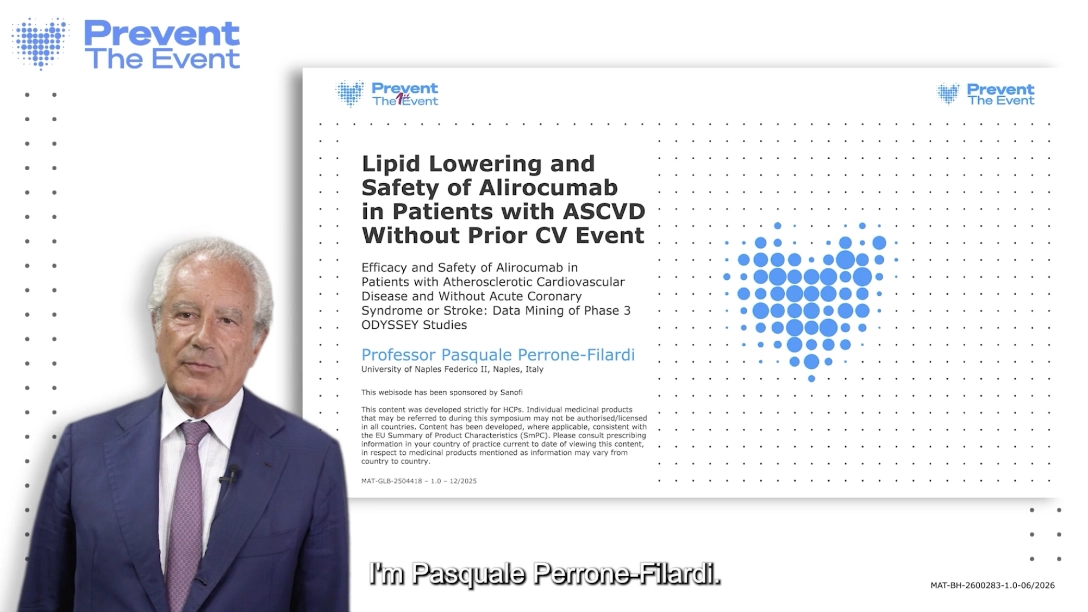
Watch Prof Perrone-Filardi's summary of the study:
Study background
- All patients with ASCVD are at very high or extreme risk of a potentially fatal CV event2
- LDL-C is the primary target for CV risk reduction and PCSK9 inhibitors such as PRALUENT can reduce LDL-C levels when used alone or in combination with statins2,3+
- However, data on the effect of PCSK9 inhibitors on CV risk in patients with ASCVD without prior ACS or stroke are limited1
- This post hoc pooled analysis sought to determine the efficacy and safety of PRALUENT in ASCVD patients who had not previously experienced a CV event1
Study Details

Design
- Pooled analysis of safety and efficacy data mined from 12 existing ODYSSEY phase 3 studies with PRALUENT

Objective
- To determine the efficacy and safety of PRALUENT vs. placebo or ezetimibe in patients with ASCVD and comorbidities, but without previous ACS (myocardial infarction/unstable angina) or stroke!

Study groups
- Pool 1: PRALUENT 75/150 mg Q2W vs. ezetimibe
- Pool 2: PRALUENT 75/150 mg QZW vs. placebo
- Pool 3: PRALUENT 150 mg Q2W vs. placebo

Primary endpoints
- Efficacy: Percentage change in calculated LDL-C level from baseline to Week 24
- Safety: Percentage of patients who experience TEAs

Population
- Adults with documented ASCVD, clinical or unequivocal on imaging, and without prior ACS or stroke1
- Subgroups of interest that were also investigated were PAD + diabetes, CAD + diabetes and clinically established CAD™
What is data mining?
Data mining refers to the process of extracting potentially useful information, such as patterns or relationships, from large and complex datasets.4
Which ODYSSEY studies were mined?1
- ALTERNATIVE
- CHOICE II
- COMBO I
- COMBO II
- DM INSULIN
- FH I
- FH II
- HIGH FH
- LONG TERM
- MONO
- OPTIONS I
- OPTIONS II
Want to learn more about PRALUENT?
Click here to find out more →
Key baseline characteristics1
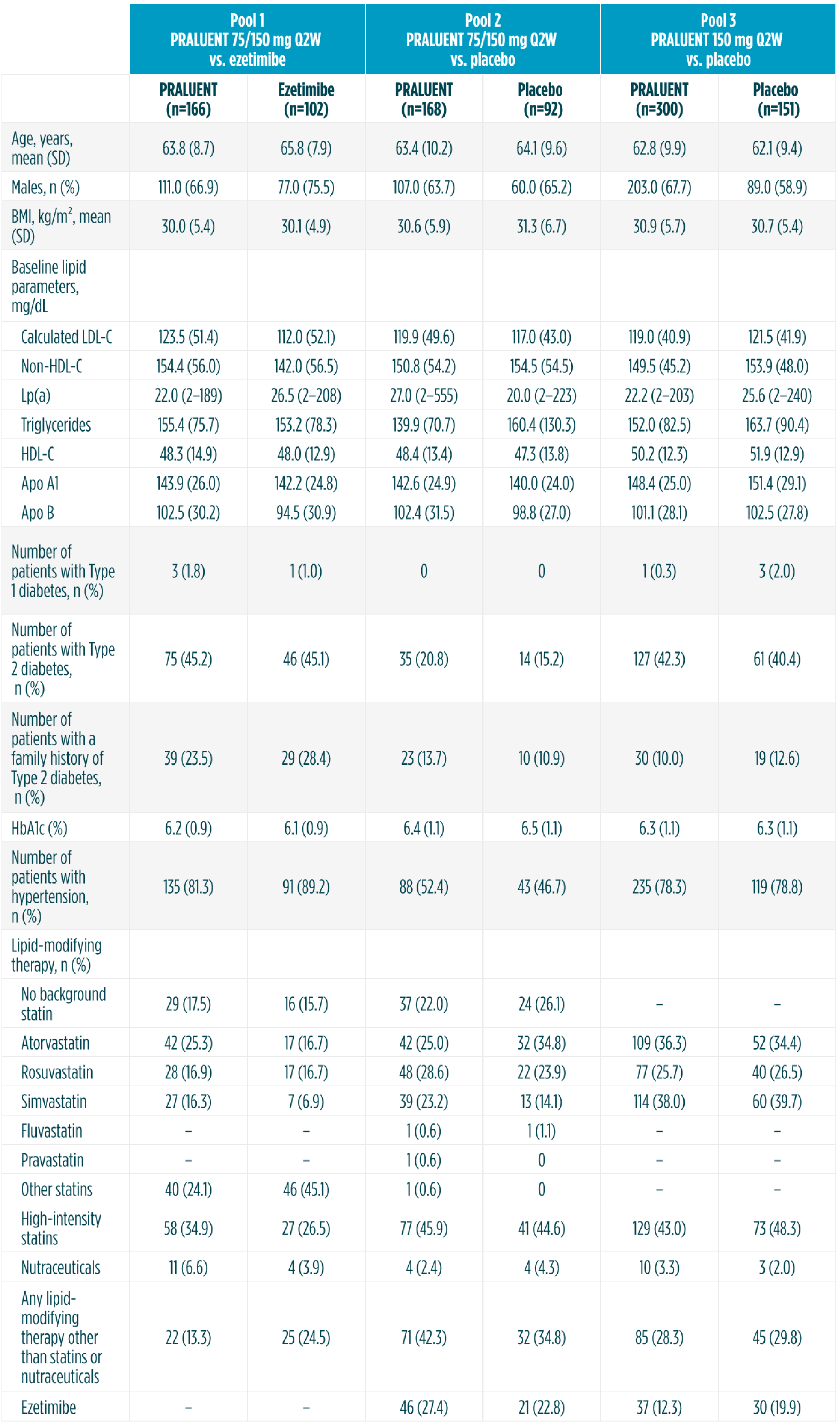
Adapted from Castro Cabezas et al. 2025.
Can you recognise very high- and extreme-risk patients like these in your practice?
Find out more here →
Efficacy results
Primary endpoint: PRALUENT demonstrated significant LDL-C reduction vs. placebo at leek 24 in ASCVD patients without previous ACS or stroke:1,*


Absolute change in calculated LDL-C at Week 24 was -71.7 mg/dL for PRALUENT and -1.5 mg/dL for placebo.1
The administration of PRALUENT resulted in a significantly greater reduction in LDL-C levels at Week 24 across all three pools:
Change in LDL-C levels from baseline to Week 24 per study group (ITT population)1
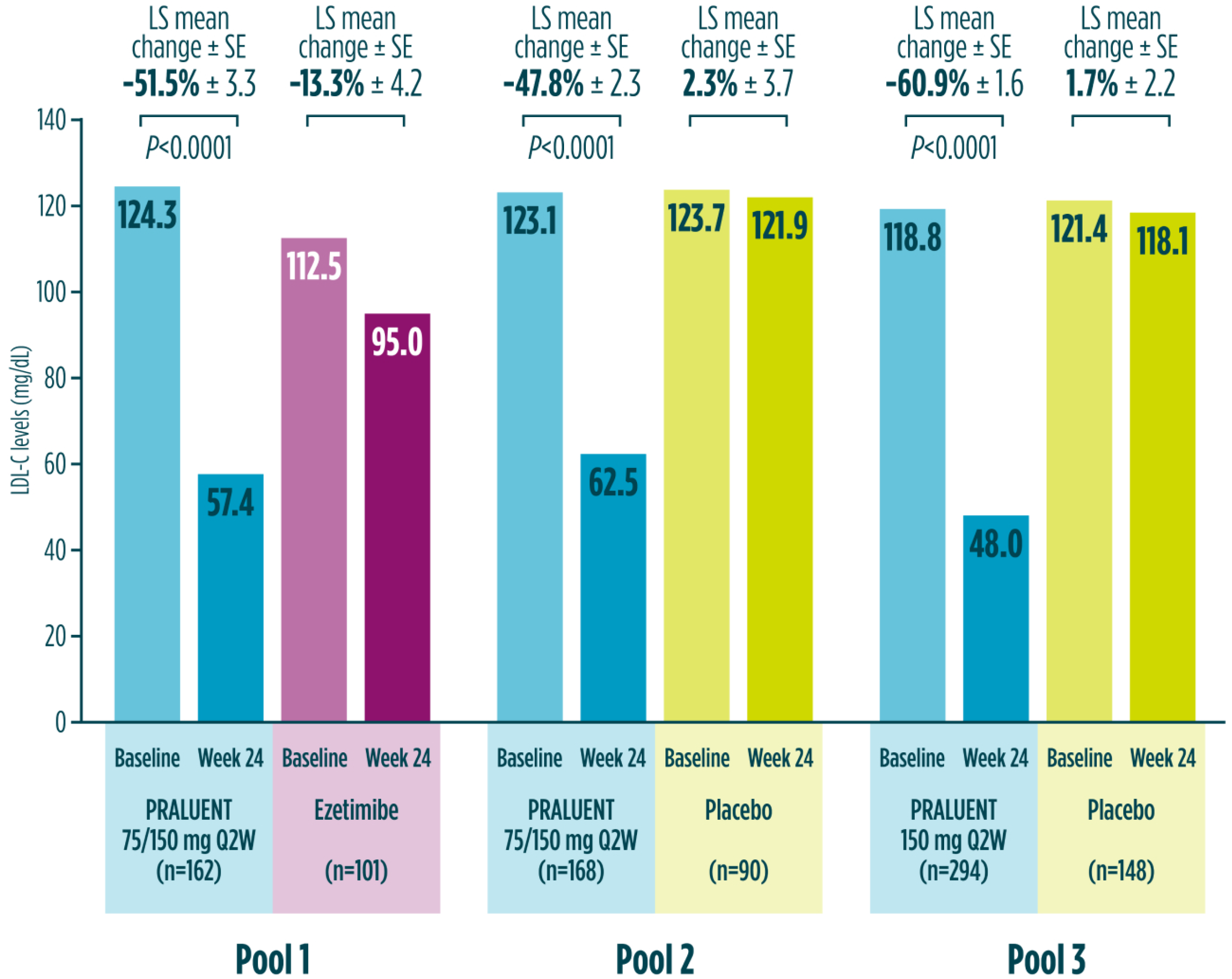
Adapted from Castro Cabezas et al. 2025.
Secondary endpoints: from baseline to Week 12, PRALUENT was associated with a significant improvement in the percentage change in calculated LDL-C levels, ApoB and Lp(a) vs. ezetimibe or placebo1
Least squared mean difference vs. placebo for patients treated with PRALUENT 150 mg Q2W in the ITT population1
|
PRALUENT (n=294) |
Placebo (n=148) |
||
| Percentage change in HDL-C (± SD) | Week 12 | 5.3 ± 0.9 | 0.6 ± 1.2 |
| Week 24 | 3.7 ± 0.8 | -1.5 ± 1.1 | |
| Percentage change in ApoA1 (± SD) | Week 12 | 2.9 ± 0.7 | 1.5 ± 1.0 |
| Week 24 | 3.5 ± 0.7 | 0.5 ± 1.0 | |
| Percentage change in ApoB (± SD) | Week 12 | -57.9 ± 1.2 | 2.1 ± 1.7 |
| Week 24 | -53.3 ± 1.4 | 0.7 ± 2.0 | |
| Percentage change in Lp(a) (± SD) | Week 12 | -28.7 ± 1.5 | -1.7 ± 2.1 |
| Week 24 | -30.4 ± 1.5 | -4.3 ± 2.2 | |
| Percentage change in fasting triglycerides (± SD) | Week 12 | -16.5 ± 1.8 | 3.6 ± 2.6 |
| Week 24 | -15.1 ± 1.8 | -1.0 ± 2.6 | |
Adapted from Castro Cabezas et al. 2025.
Subgroup analyses: consistently greater LDL-C reduction with PRALUENT vs. ezetimibe or placebo achieved across patients with CAD + diabetes and established CADI
CAD + diabetes:1
62.6% LDL-C reduction
with PRALUENT 150 mg Q2W (n=113)
vs. 7.6% increase for placebo (n=48)
at Week 24 (P<0.0001)
Absolute change in calculated LDL-C at
Week 24 was -72.3 mg/dL for PRALUENT
and -1.8 mg/dL for placebo.1
Established CAD:1
61.7% LDL-C reduction
with PRALUENT 150 mg Q2W (n=246)
vs. 0.2% increase for placebo (n=114)
at Week 24 (P<0.0001)
Absolute change in calculated LDL-C at
Week 24 was -73.3 mg/dL for PRALUENT
and -1.9 mg/dL for placebo.1
Safety results
PRALUENT was generally well tolerated, with a similar safety profile to control arms across all study groups
- TEAEs were experienced by 76.5% and 74.8% of patients and SAEs were experienced by 13.7% and 15.7% of patients in the ezetimibe and PRALUENT (75/150 Q2W) groups, respectively1
- TEAEs were experienced by 78.9% and 81.4% of patients and SAEs were experienced by 19.4% and 18.6% of patients in the placebo and PRALUENT (75/150 mg or 150 mg Q2W) groups, respectively1
Adverse event profile for ASCVD patients with CAD or PAD + diabetes or established CAD treated with PRALUENT vs. ezetimibe and placebo1
| PRALUENT 75/150 mg Q2W vs. ezetimibe | PRALUENT 75/150 mg Q2W vs. placebo | |||
| PRALUENT (n=166) | Ezetimibe (n=102) | PRALUENT (n=468) | Placebo (n=242) | |
|
Patients with any TEAE, n (%) |
124 (74.8) | 78 (76.5) | 381 (81.4) | 191 (78.9) |
|
Patients with any treatment-emergent SAE, n (%) |
26 (15.7) | 14 (13.7) | 87 (18.6) | 47 (19.4) |
|
Patients with any TEAE leading to permanent treatment discontinuation, n (%) |
15 (9.0) | 14 (13.7) | 33 (7.1) | 14 (5.8) |
|
Patients with any TEAE leading to death, n (%) |
2 (1.2) | 1 (1.0) | 4 (0.9) | 1 (0.4) |
Adapted from Castro Cabezas et al. 2025.

PRALUENT significantly reduced LDL-C levels vs. ezetimibe and placebo and was well tolerated among patients with ASCVD without previous ACS or stroke1

Do you know when guidelines recommend initiating a PCSKi?
Find out more here →
Want to see more safety and efficacy data for PRALUENT?
Find out more here →
Indication, dosing and footnotes
This material is intended for healthcare professionals only.
PRALUENT (alirocumab) indication5
Primary hypercholesterolaemia and mixed dyslipidaemia
PRALUENT® is indicated in adults with primary hypercholesterolaemia (heterozygous familial and non-familial) or mixed dyslipidaemia, and in paediatric patient 3 years of age and older with heterozygous familial hypercholesterolaemia (HeFH) as an adjunct to diet:
- in combination with the maximum tolerated dose of a statin with or without other lipid-lowering therapies or,
- alone or in combination with other lipid-lowering therapies in patients who are statin-intolerant, or for whom a statin is contraindicated
Dosing informations5
The recommended PRALUENT doses are 75 mg once every 2 weeks, 150 mg once every 2 weeks, 300 mg once every 4 weeks (monthly), administered subcutaneously. All doses may be used for initiation of treatment.
The dose of PRALUENT can be individualised based on patient characteristics, such as baseline LDL-C level, goal of therapy, and response to treatment. Lipid levels can be assessed 4 to 8 weeks after treatment initiation or titration, and dose adjusted accordingly (up-titration or down-titration). Intense LDL-C reduction is expected with PRALUENT 150 mg once every 2 weeks and 300 mg once every 4 weeks (monthly), where 150 mg once every 2 weeks is the maximum dose.
For the treatment of HeFH in paediatric patients 8 years of age and older:
- for patients with a body weight of less than 50 kg, the recommended dose is 150 mg once every 4 weeks and, if additional LDL-C reduction is needed, a dose of 75 mg once every 2 weeks is recommended
- for patients with a body weight of 50 kg or more, the recommended dose is 300 mg once every 4 weeks and, if additional LDL-C reduction is needed, a dose of 150 mg every 2 weeks is recommended
*Of 3,115 very high-risk patients (including people with HeFH) and people with established CVD but without ACS or stroke, 979 had CAD or PAD + diabetes or established CAD.1
†PRALUENT is indicated in adults with established atherosclerotic cardiovascular disease to reduce cardiovascular risk by lowering LDL-C levels, as an adjunct to correction of other risk factors: in combination with the maximum tolerated dose of a statin with or without other lipid-lowering therapies or alone or in combination with other lipid-lowering therapies in patients who are statin-intolerant, or for whom a statin is contraindicated.5
‡PAD + diabetes comprised patients with diabetes and a medical history of intermittent claudication together with ankle-brachial index ≤0.90, or together with peripheral revascularisation procedure/surgery, or critical limb ischaemia together with peripheral revascularisation procedure/surgery or thrombolysis. CAD + diabetes comprised patients with diabetes and a medical history of acute myocardial infarction, unstable angina, CAD, or coronary revascularisation. Clinically established CAD was defined as having a medical history of at least one of the following: angina pectoris, coronary angioplasty, coronary arterial stent insertion, coronary artery bypass, coronary artery surgery, coronary endarterectomy, coronary revascularisation, percutaneous coronary intervention.¹
¥The subgroup PAD and diabetes was not analysed as a result of the small sample size (n=64).¹
ACS = acute coronary syndrome; Apo A1 = apolipoprotein Al; Apo B = apolipoprotein B; ASCVD = atherosclerotic cardiovascular disease; BMI = body mass index; CAD = coronary artery disease; CV = cardiovascular; CVD = cardiovascular disease; HbAlc = glycated haemoglobin; HDL-C = high-density lipoprotein cholesterol; HeFH = heterozygous familial hypercholesterolaemia; ITT = intention-to-treat; LDL-C = low-density lipoprotein cholesterol; Lp(a) = lipoprotein (a); LS = least squared; PAD = peripheral artery disease; PCSK9 = proprotein convertase subtilisin/kexin type 9; PCSK9i = proprotein convertase subtilisin/kexin type 9 inhibitor; Q2W = every 2 weeks; SAE = serious adverse event; SD = standard deviation; SE = standard error; TEA = treatment-emergent adverse event.
- Castro Cabezas M, Orsini M, Tokgözoğlu L, et al. Efficacy and safety of alirocumab in patients with established atherosclerotic vascular disease before the first cardiovascular event: pooled analysis of phase 3 ODYSSEY studies. J Clin Lipidol. 2025;S1933-2874(25)00482-9.
- Mach F, Koskinas KC, Roeters van Lennep JE, et al. 2025 Focused Update of the 2019 ESC/EAS Guidelines for the management of dyslipidaemias. Eur Heart J.2025;46(42):4359-4378.
- Schwartz GG, Steg PG, Szarek M, et al. Alirocumab and cardiovascular outcomes after acute coronary syndrome. N Engl J Med. 2018;379(22):2097-2107.
- Yang J, Li Y, Liu Q, et al. Brief introduction of medical database and data mining technology in big data era. J Evid Based Med. 2020;13(1):57-69.
- PRALUENT (alirocumab) Summary of Product Characteristics. Gulf: sanofi-aventis groupe; Nov 2023.