Tolerability of Accelerated Agalsidase Beta Infusions in Fabry Disease: The SHORTEN Study Analysis
Evaluating Safety and Tolerability of Differing Infusion
|

Emerging evidence |
||
|
• A Japanese post-marketing study showed patients <30 kg with classic FD tolerated 1 mg/kg/hour, completing infusions in 60 minutes.1 |
||
Unmet evidence gap |
||
|
• Safety of <90-minute infusions is not well established.1 • Limited data on infusion-associated reactions and adverse events at higher rates.1 |
||
Study objective |
||
|
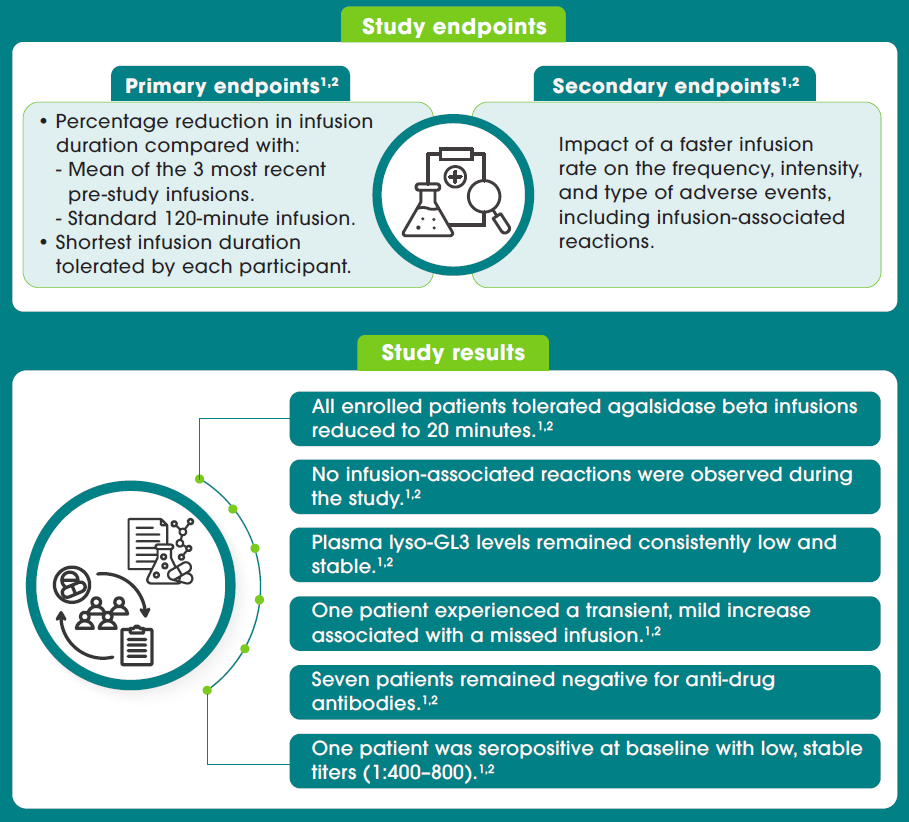
• To evaluate safe infusion-rate escalation to reduce the long-term treatment burden of agalsidase beta.1,2 |
||
Study design and eligibility criteria |
||
|
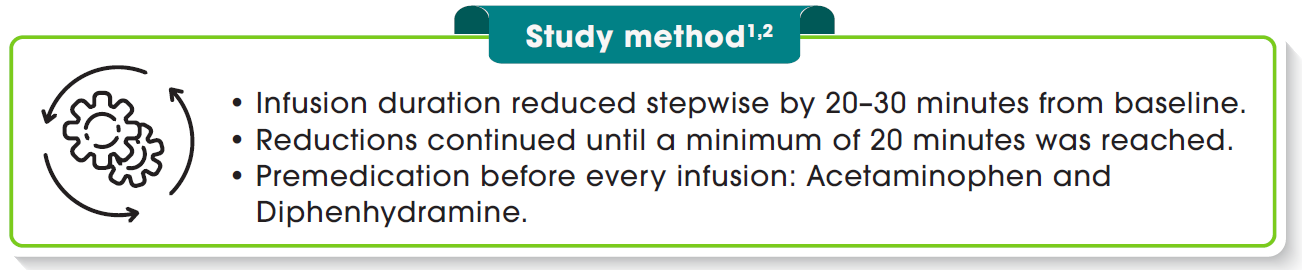
The study was designed as a phase 4, open-label, single-arm, multicenter trial.1,2 |
||
Patient population1 |
|
Inclusion criteria |
Exclusion criteria |
|
• Participants aged ≥2 to ≤65 years with confirmed FD
|
• Pregnant or breastfeeding
|
Abbreviations
αGAL ERT: Alpha-galactosidase enzyme replacement therapy, FD: Fabry disease, mg/kg: milligrams per kilogram, FDA: Food and Drug Administration, lyso-GL3: globotriaosylsphingosine.
-
Banikazemi M, Goker Alpan O, Nedd K, Sarkar M, Wilcox WR, Lee C. Safety and tolerability of accelerated agalsidase beta infusions (<20 min) in patients with Fabry disease: Results from the SHORTEN Study. Nephrol Dial Transplant. 2025; 40(Suppl 3):gfaf116.0144.
-
Banikazemi M, Goker Alpan O, Nedd K, Sarkar M, Wilcox W, Lee C. A phase 4 study to evaluate the safety and tolerability of higher infusion rates of agalsidase beta to shorten the infusion duration in Fabry disease—Preliminary data. Nephrol Dial Transplant. 2025;40(Suppl 3):gfaf116.0144.